Adyar is the International Headquarters of The Theosophical Society, The International Convention
In December every year, the northeast monsoon departs, leaving the Estate fresh, alive, green and nourished. A few weeks later, from 26 to 31 December, an important event for Theosophists takes place: the International Convention. There have been more than one hundred such gatherings and, except on a few rare occasions, they have been at Adyar. Delegates arrive from everywhere, the majority from the Indian sub-continent, but they also come from other countries all over the world. Their number fluctuates between 1,000 and 1,500 but on special occasions like the Adyar Centenary Convention in 1982, it goes up to 2,000 or even more. The Convention transforms the tranquil Adyar Estate into a busy centre with delegates accommodated in the main guesthouses, private homes, and other buildings.
They come to participate in what is a unique annual international gathering, and to see Adyar, 'The Home of the Masters.' The Convention is also an opportunity for members of the Society from many lands to become acquainted with the international fraternity and meet old friends.
There is a great deal of activity at this time; services include information booths, book displays and sales, outings and sightseeing tours, bicycle hires, the sale of fresh vegetables, fruits, and tender coconut drinks, and the serving of South Indian snacks at a large palm-leaf restaurant. During the period of the Convention, through lectures, some of them by eminent Theosophists, philosophers, scientists and thinkers, and through symposia, dialogues and discussions, the members of the Society examine and explore, in the context of the present-day world and individual problems, the meaning and significance of Theosophy. N. Sri Ram at the 88th International Convention said: "Every Convention is a kind of peak we ascend as well as an occasion from which to look back and look forward. It provides an atmosphere in which each of us can best realize what this movement is intended to achieve and what one can do to help it."
Persons interested in attending the Convention have to write, not before September to:
The Convention Officer,
The Theosophical Society,
Adyar, Chennai- 600020, India
"Good actions give strength to ourselves and inspire good actions in others." Plato
Library
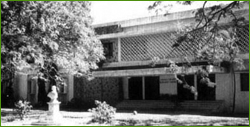
The Adyar Library and Research Centre was founded in 1886 by Colonel Olcott with a small but valuable collection of the Founders' books. Originally situated in the Headquarters building, it was shifted in 1968 to a more spacious one, better suited to its growing needs. It has always been one of the important aspects of the work at Adyar, both for members and for the public; moreover, today it is one of the most important oriental libraries in the world, dedicated to research and publication in the field of eastern civilization, philosophy and religion.
It contains over 250,000 printed volumes and nearly 20,000 palm-leaf manuscripts from India, Sri Lanka, China, and other places, a few of which are kept on display for visitors. The printed books include rare indological publications in several languages and a fine collection of works on different religions, philosophies and cultures. The Chinese Tripitakas, the Tibetan Kanjur and Tanjur, a collection of rare works in Latin and other western languages, and a complete set of important research journals are among the priceless possessions of the Library. It also currently receives nearly 225 journals from several countries.
Several rare and previously unpublished works in the manuscript collection have been edited and brought out in print; a staff of pundits and scholars is continually engaged on this task. The Library has had a series of distinguished scholars as its Director and is recognized as a Research Centre for a Ph.D. in Sanskrit and Indology by the University of Madras. The Library also publishes a scholarly journal called Brahma-vidya, which presents studies on religion, philosophy, culture, and various aspects of indology: this journal circulates among scholars throughout the world. Further, the Library extends its services to research institutions, universities and scholars in India and abroad, and supplies microfilm and photostat copies on request. Its manuscripts have been used in several important publications of other institutions of learning.
The Library has achieved much during its hundred and more years of existence but there is still much to be done. Shortage of funds makes it difficult to engage suitable scholars and add to its collections. Therefore, an Adyar Library Endowment Fund was created in 1986, in the hope that members of the Society as well as others interested in this work would support it. Its other Publications include: VΝda and VΝd,nta, Upanishads, Dharma S,stra, Artha S,stra, Astrology, Grammar, MΣm,msa, Music, Lexicography, Poetics and Dramaturgy.
The Theosophical Publishing House
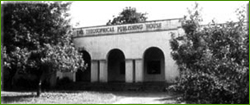
The Theosophical Publishing House, a department of the Theosophical Society, started at the beginning of this century, has published over 700 titles dealing with Theosophy, different religions, philosophy, yoga, science, occultism, meditation, and so on by well-known authors like H.P. Blavatsky, H.S. Olcott, Annie Besant, C.W. Leadbeater, Geoffrey Hodson, N. Sri Ram, I.K. Taimni and others.
Oriental works published by the Adyar Library and Research Centre are distributed by the Theosophical Publishing House. It has brought out, in addition, a large number of pamphlets and booklets. It distributes worldwide, The Theosophist, a monthly journal started in 1879 by H.P. Blavatsky, Wake Up India and the quarterly Adyar Newsletter.
The Theosophical Publishing House also runs a well-stocked bookshop adjacent to the main gate of the Estate. In addition to theosophical literature, it offers for sale books from other publishing houses on religion, yoga, mysticism, philosophy and allied subjects. The Vasanta Press prints all the publications of the Theosophical Publishing House, The Adyar Library and Research Centre, and allied organizations. Its professional performance is of such quality that the first prize for excellence in printing was awarded to it in 1987 by the All India Printers' Conference.
Hall
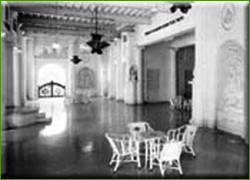
Theosophy or the perennial wisdom, being the root of all religions, proclaims their unity. The Headquarters Hall symbolizes that unity. On entering the hall, one sees in the alcove behind a marble platform a figure in plaster of H. P. Blavatsky modeled from Schmiechen's portrait of her. The statue bears an inscription in Latin by Colonel Olcott: "HPB Amicitiae nostrae testimonium. H.S.O. 8.5.1899."
When Colonel Olcott passed away in 1907, a plaster statue of him was placed by the side of Madame Blavatsky and an inscription engraved on the pedestal: 'The Founders of the Theosophical Society: Helena Petrovna Blavatsky 1831-1891-Henry Steel Olcott 1832-1907'. Along the walls of the hall are bas-relief symbols and figures: those on the north, east and west represent living religions-Christianity, Buddhism, Hinduism, Zoroastrianism, Islam, Jainism, Judaism, Taoism, Confucianism, Shintoism, and the Baha'i religion.
The south wall represents the extinct religions. In the west is a large board on which are inscribed the names of all the Sections of the Theosophical Society with the dates of their formation. The Theosophical Society, with its motto, There is no Religion higher than Truth, is represented by its symbol on the south side. On the north side are pedestals bearing the busts of Colonel Olcott, the President-Founder, and Annie Besant, the second President.
