Sri Ram
JPresident of the Theosophical Society during,
1953-1973
"There is no wisdom without love"
N. Sri Ram
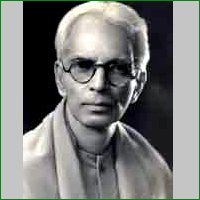

JPresident of the Theosophical Society during,
1953-1973
"There is no wisdom without love"
N. Sri Ram
A Distinguished Theosophist By Radha Burnier The Theosophists, December 1989 On 15 December 1989 falls the birth centenary of N. Sri Ram, fifth President of the Theosophical Society. For thirty years before he took charge as President on 17 February 1953, he worked in many capacities for the Society. As a youth graduated out of college he taught in theosophical schools, first at Madanapalle and later in Bangalore and Madras.These schools were started as part of the country-wide educational movement organized by Annie Besant. They played an important role in awakening the young Indians of the day to their heritage and responsibilities as future citizens of a free India.
On 15 December 1989 falls the birth centenary of N. Sri Ram, fifth President of the Theosophical Society. For thirty years before he took charge as President on 17 February 1953, he worked in many capacities for the Society. As a youth graduated out of college he taught in theosophical schools, first at Madanapalle and later in Bangalore and Madras.These schools were started as part of the country-wide educational movement organized by Annie Besant. They played an important role in awakening the young Indians of the day to their heritage and responsibilities as future citizens of a free India.
Education was only one aspect of the great range of work carried on by Theosophists in India under the leadership of Dr Besant. Many bright young men and women threw up their careers in order to serve under her and bring about a renaissance of culture and spirituality in the motherland and through it in the world. She initiated a dynamic programme to reform the social system and set into motion the Home Rule movement. Among the ardent assistants who worked under her inspiration, unconcerned about worldly success and security, was Sri Ram.
After his initial work as a teacher, he engaged in a voluntary lecture programme for Theosophy and Home Rule. He was also active under Dr Besant's aegis in the labour union movement, demanding proper treatment for workmen at a time when poor labourers had no protection against exploitation. While he was Assistant Editor of the daily New India published by Annie Besant, his acumen and talents as a writer and editor developed.
The name 'Sri Ram' was symbolic of the break he made from the caste system of his time. He dropped the suffix 'Sastri' or 'Sarma', which indicated birth in the brahman caste and would have been normally appended to the name at that time. Though he incurred the wrath of orthodox society, he was firm in abandoning meaningless conventions and superstitious customs not consonant with the principles of Theosophy.
Sri Ram's theosophical career included various terms as Treasurer, Recording Secretary and Vice-President of the Society. More than one President leaned upon him for assistance in carrying out his duties and passed on to him problems and questions which came up. He was fully familiar with all the aspects of the work of the Society when he himself was elected to the office of the President.
Until he passed away on 8 April 1973, Sri Ram travelled, lectured and wrote without respite and fulfilled with serene composure the heavy duties that fall upon the shoulders of a President. The theosophical way of life came naturally to him. His younger brother N.S. Sastry summed it up in the words (see June 1973 Theosophist) 'born renounced'. He did not have to strive to practise detachment, humility, generosity, sympathy or serenity: this was second nature to him, no doubt because he had set himself on the path to Wisdom in previous incarnations. The remark was made that Sri Ram 'suffered fools gladly'; he had no difficulty in perceiving goodness in others, and hence no experience of 'suffering' with whomever he was. This was part of his innate wisdom.
Few knew that he gave away generously of the little he had. Like Annie Besant, he had known hard times and his heart went out readily towards those who were in need. His life was so simple, one may say austere, that when requests came for mementoes after his passing, it was hard to comply with, for he possessed little. I remember giving him an extra pen, keeping in mind the writing he had to do, but within a few weeks it was in the hands of someone else.
The impact of his thought on the T.S. was great, but people hardly knew that a change was being brought about for he could accomplish much without seeming to do so. He emphasized the need to consider all questions for oneself, avoiding dogmatic decisions and attachment to non-essentials. Pronouncements of an occult nature taken earlier as matters of belief became under his influence matters to be considered with common sense. He did not encourage belief or rejection, for when facts are not verifiable wisdom calls for the withholding of judgement.
Though it was not his custom to criticize or condemn people for faults or failings, he was neither sentimental nor lacking in insight. He observed the quirks and characteristics of people with discriminating awareness, infused with kindly humour and deep understanding. He acted with consideration in all situations, trivial or important. While correcting proofs, he would carefully substitute words to fit into the space made by deletions, to make the work easier for the Vasanta Press. His corrections were always clear and legible, for he would not impose a burden on compositors who did not know English. On the last day of his earthly life, when he was informed that he had had a heart attack, his immediate concern was that it would cause trouble to others.
Many changes took place at Adyar during his twenty-year Presidency. It was then that the present building of the Adyar Library and Research Centre was constructed and the library shifted from the headquarters building where it was originally housed by Colonel Olcott. The Vasanta Press too found a new home in Besant Gardens during his term of office. The School of the Wisdom received new lustre by his regular talks there. A number of these have now been put together as a book entitled The Way of Wisdom.
His method of working was never to command. He attracted co-operation and loyalty from his colleagues by making them feel a sense of closeness. He was like an elder brother in their midst; in fact, quite a few called him 'Anna', which in this part of South India means 'elder brother'. Everyone could go to him freely with his problems or requests; he was the most approachable of persons. Though he had a heavy burden to carry he never gave anyone an impression of being too busy or hard-pressed.
The life of such a person of peace, wisdom and simplicity will be remembered long in the Society even by those who did not have the opportunity to come into personal contact with him, for it has had far-reaching effects on the course of theosophical history
In addition to some autobiographical remarks, we carry in this issue a few unpublished talks, not revised by him but slightly edited by us. We also reproduce select photographs taken during his extensive travels as well as reminiscences and assessments of his personality and work by a few who knew him.